Origin data to filed DDS
EUDR compliance that starts where your plot data already lives.
Grovetrace pulls supplier and plot data out of the ERPs, farm-data tools and co-op spreadsheets it is stuck in, and ties every cocoa batch to the land it grew on. That becomes the Due Diligence Statement every shipment needs in TRACES from 30 December 2026.
SHP-2026-0431CoveredTema to Antwerp, arriving 14 November
DDS-2026-0288FiledWhere EUDR compliance breaks down
Supplier and plot data sit in ERPs, farm-data tools, co-op spreadsheets and email attachments, and they do not line up. Polygons arrive late, malformed or overlapping, and the submission that fails is yours.
Grovetrace covers two things in depth: getting messy origin data in, and getting an accepted DDS out. It is built for the EU Deforestation Regulation alone, and the platform page sets out the scope it deliberately leaves to other tools.
- Geometry
- Points and polygons
- PostGIS at SRID 4326. A plot is unique per supplier, so the same farm arriving from two sources resolves to one plot.
- Isolation
- Org-scoped, every query
- Multi-tenant by organization. Anything the tenancy map does not cover is hidden by default.
- Deforestation
- Global Forest Watch
- Each plot carries the provider’s verdict, its date and its confidence. Resolving a plot never overwrites that verdict.
- Risk
- The Annex I factors
- Country, deforestation, legality and traceability completeness, with the mitigation applied before the conclusion.
- TRACES
- Submit, amend, withdraw
- Statements are filed in the EU’s own system, and the reference it returns is stored against the shipment.
End-to-end EUDR due diligence
Four stages carry a co-op spreadsheet through to a statement TRACES accepts.
- Ingest
Connect the systems your origin data already sits in
ERP exports, farm-data platforms, co-op spreadsheets and CSV. Each source is mapped once (farmers to suppliers, plots to land plots, lots to batches) and Grovetrace keeps pulling on a schedule.
How ingestion works - Resolve
Supplier and plot identity resolved on ingest
The ERP holds a vendor code, the field tool a farmer ID, the co-op spreadsheet a name spelled three ways. Grovetrace resolves all three to one supplier and one plot as the data arrives, so your team is not reconciling them per shipment.
See the data model - Assess
Deforestation and Annex I risk, assessed per consignment
A Global Forest Watch verdict on every plot, and the full set of Annex I risk factors per consignment. Each assessment is stored with the check that produced it, so the conclusion can be defended years later.
What gets assessed - File
Submission to TRACES, with the reference stored
Submit, amend and withdraw are all supported, for domestic and import declarations. The reference TRACES returns is held against the shipment, and a rejection reopens as an item on the worklist.
The filing step
How it works
Four steps, from connecting your first source to defending a filed statement years after the container cleared.
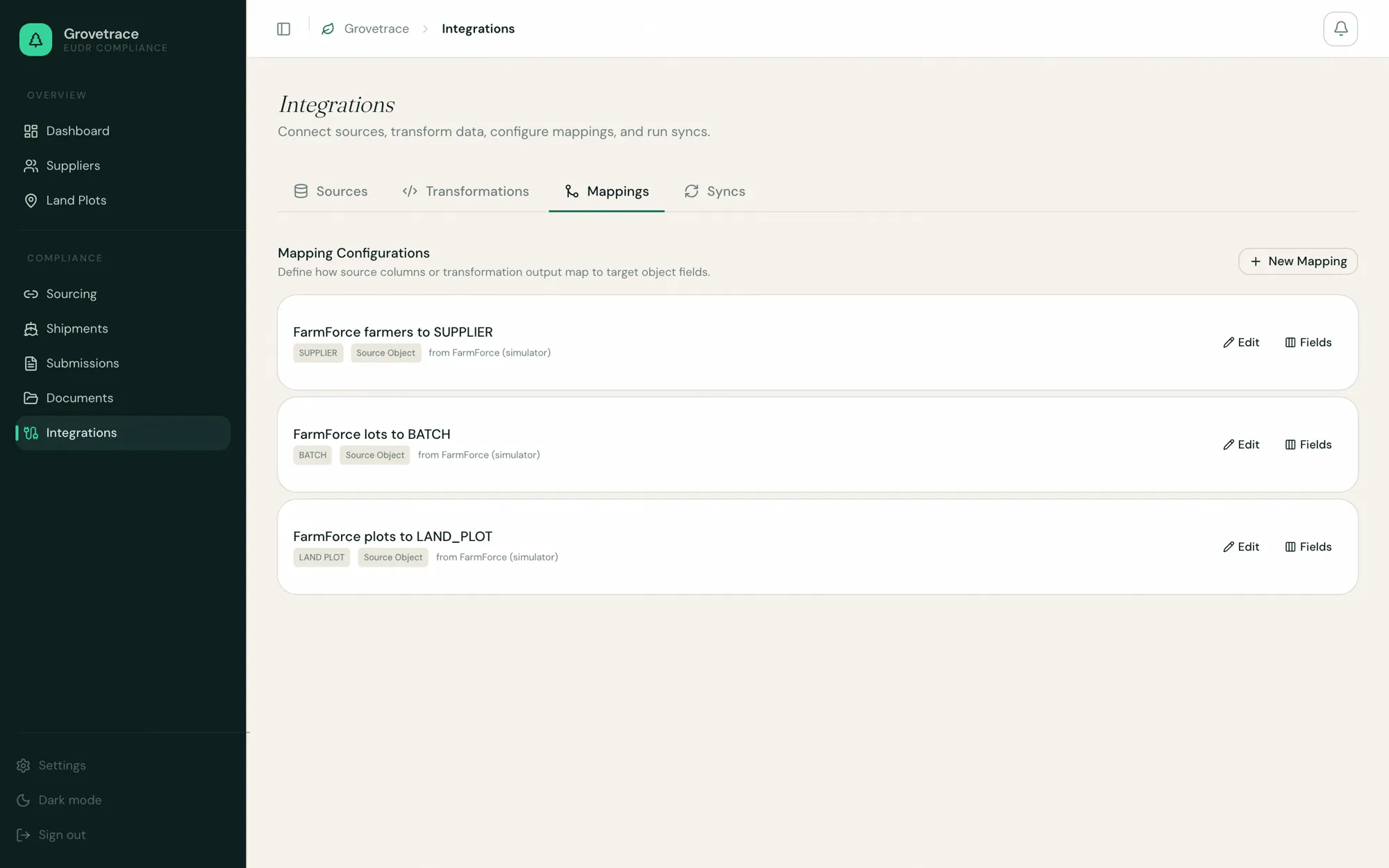
Connect the systems you already run
Field-data tools, ERP exports, co-op spreadsheets and CSV. You map each source once (farmers to suppliers, plots to land plots, lots to batches) and Grovetrace keeps pulling on a schedule. Nothing changes at origin: your cooperatives carry on working the way they already do.
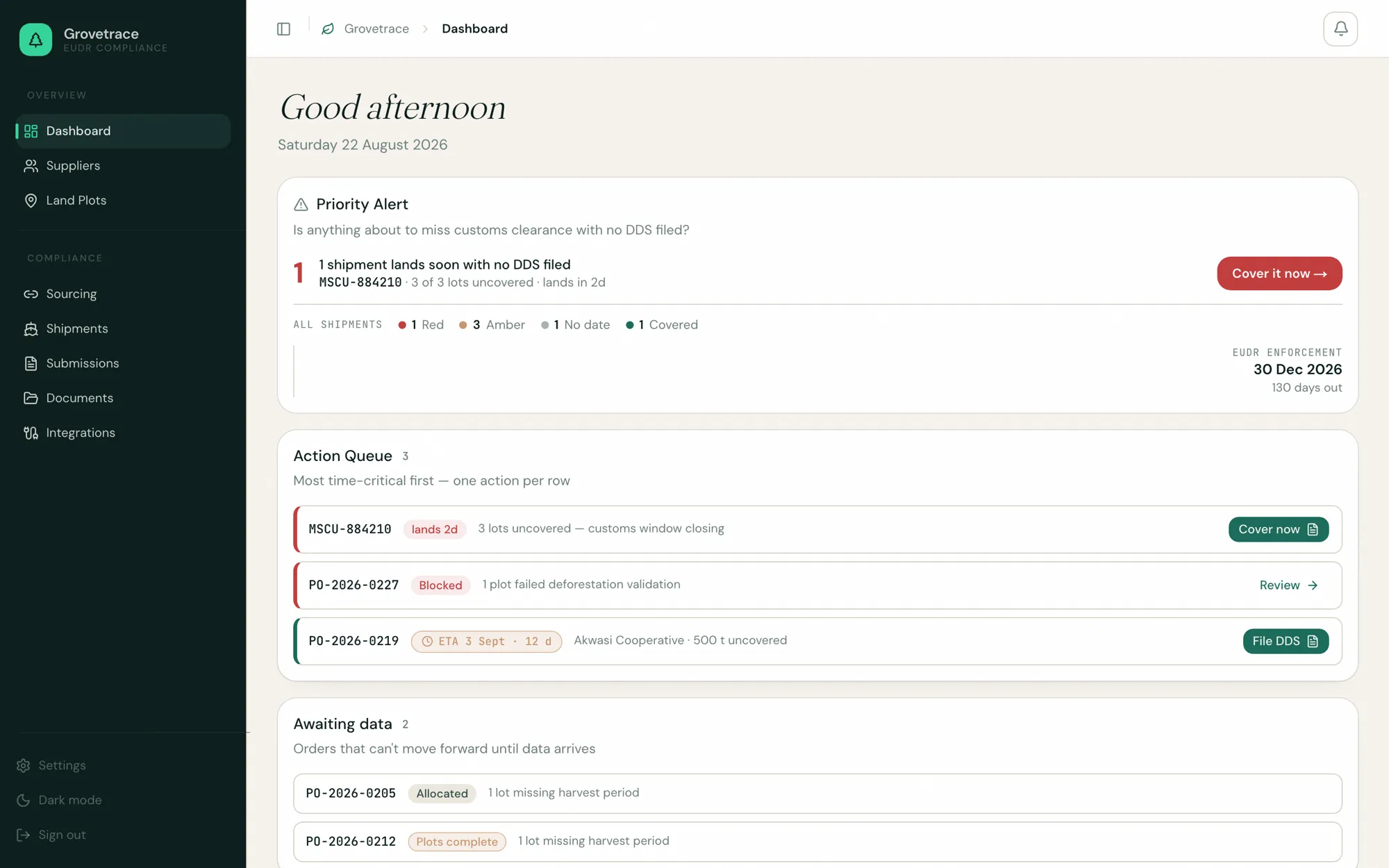
See where every shipment stands
The dashboard opens on the shipments at risk of reaching customs with no statement filed. Each one carries a red, amber or covered status with the enforcement date counting down beside it, so there is no report to run and no spreadsheet to reconcile.
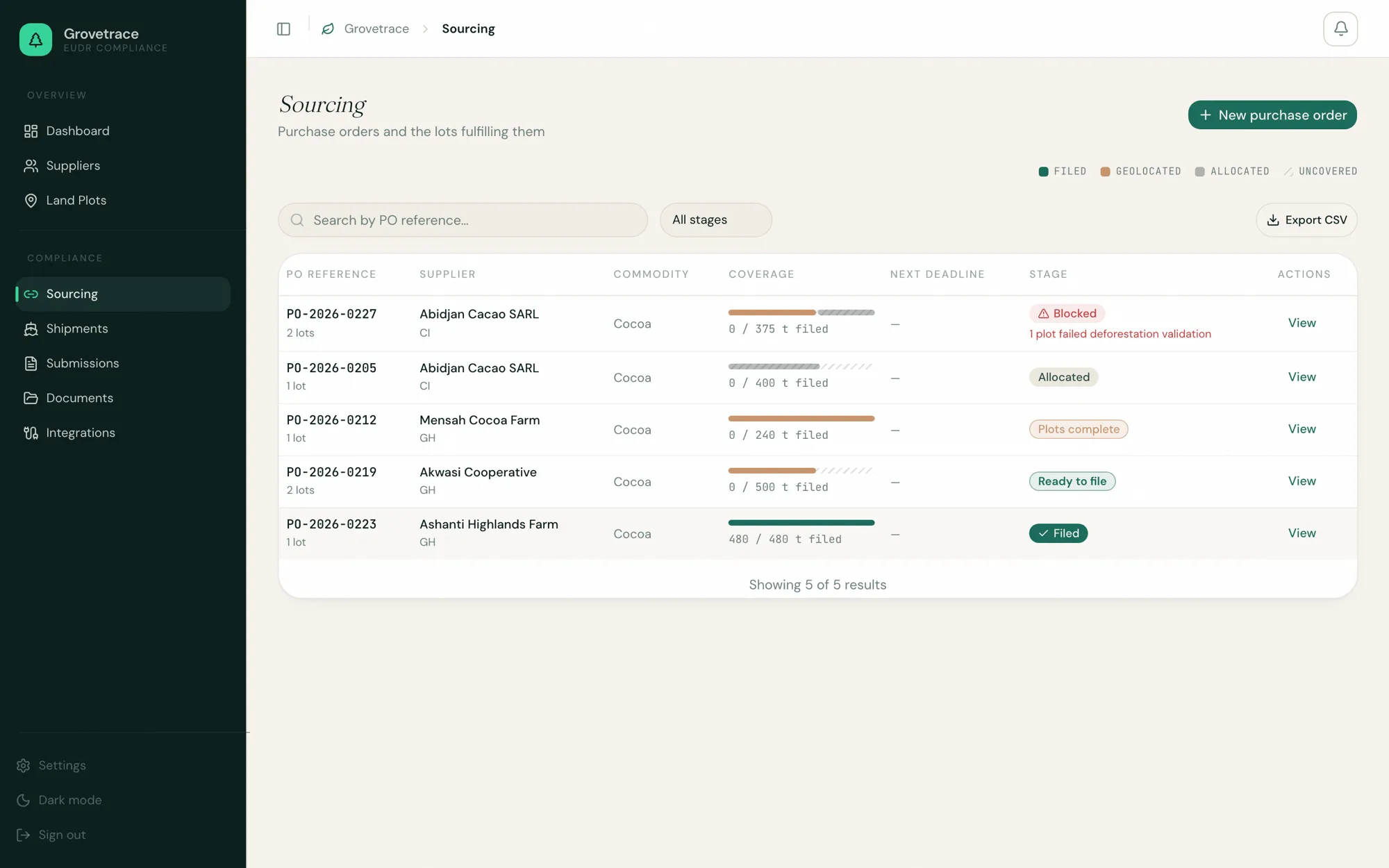
Work the queue in deadline order
The action queue is ordered by what runs out of time first, one action per row: cover this shipment, review this blocked plot, file this statement. Orders that cannot move are grouped under what they are waiting for, so a blocked order never reads as an urgent one.
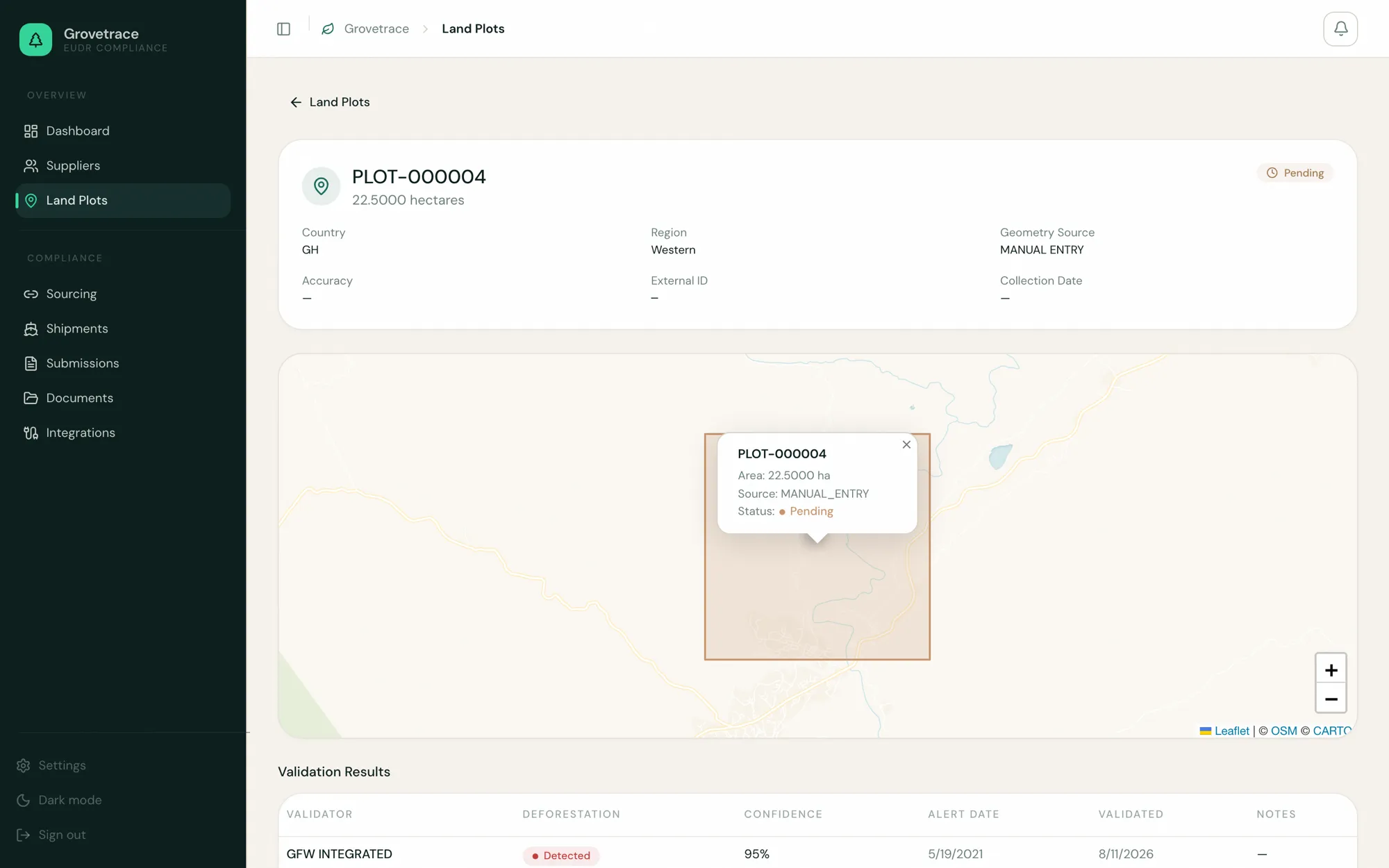
Trace every batch back to the plot it grew on
Plot geometry, its deforestation validation result and the batches it feeds are held together in one record. When a statement is examined years later, the evidence behind it is one click from the shipment.
Built for cocoa first
Cocoa concentrates the hardest parts of EUDR due diligence. These four decide whether a statement can be filed for a real, blended shipment.
Smallholder plots at the 4-hectare threshold
The regulation accepts a point for a farm under 4 ha and requires a polygon at or above it. In Ghana, Côte d’Ivoire, Ecuador, Peru, Cameroon and Nigeria that data arrives from cooperatives in whatever shape they keep it, and all of it still has to reconcile.
Aggregation and blending
Beans from many farms become one lot, one container, one shipment. Grovetrace models the join explicitly, so a filed DDS can name every plot behind a blended batch.
Cooperatives in the middle of the chain
Your supplier is usually a cooperative and only occasionally the farmer. Grovetrace records the consolidation step itself (farmer batch, cooperative, exporter), keeping the plots behind a cooperative delivery traceable through the point of aggregation.
The systems cocoa already runs
Field-data tools, ERP exports and cooperative spreadsheets, ingested where they are. No rip-and-replace, and no new software for anyone at origin to adopt.
See it on your own supply chain
Twenty minutes, screen shared, on your own supply chain. Bring the part of your data that worries you most: thirty cooperative formats, plots that will not reconcile, or a blend nobody can trace back.